


“So if I ate this every day, would I become fat?” my girlfriend asked me as we sat in our favorite ramen place on a rainy Saturday night in Dallas.
As I sipped from the decorative koi bowl and twirled the noodles around, I wondered about this.
Could something as tasty and satisfying as ramen actually be good for us?
Every time I leave the ramen shop, I feel incredible — my sleep is deeper, and my stomach feels great. Maybe there are key nutrients hidden in something as hearty and comforting as ramen. Or maybe my taste buds and cells are guiding my intuition, telling me I should eat more ramen…
That’s where my investigation led me.
Most of my life, I grew up believing that to look fit and have a six-pack, you had to eat chicken and broccoli and resist all forms of fun food.
You might feel the same. Every time you go out for something like ramen, you feel that twinge of guilt — thinking, “Damn, I’m cheating on my diet. Guess I’ll have to burn all this off on the treadmill tomorrow.”
So you start to limit yourself, punish yourself, and avoid anything that actually tastes good.
I lived that life for years — restricting myself to all-meat diets or going fully vegetarian, chasing strength and all-day energy.
But over the past six years, diving deep into nutrition, holistic health, and what actually makes a body thrive, I’ve realized our favorite foods might not need to be off the menu after all.
In fact, some of the foods we love — like ramen — could actually play a key role in adding more minerals and vitamins to our diet.
So maybe ramen isn’t just a cheat meal. Maybe it’s something our bodies actually need.

The Science Behind Ramen
My investigation led me back to one of the best health books I’ve ever read — Deep Nutrition by Dr. Catherine Shanahan.
Shanahan isn’t your typical wellness author. She’s a physician and researcher who became fascinated by some of the fittest and most naturally beautiful people on Earth.
Her question was simple: What are they eating?
She traveled across the world studying ancient tribes and traditional cultures — and found that their diets consistently correlated with both health and beauty. These people, living in remote villages, somehow had perfect posture, strong bones, and striking facial symmetry.
They didn’t have plastic surgeons or protein powders — just ancestral foods prepared with care.
I actually first discovered Deep Nutrition years ago, during one of my corporate internships. They stuck me in the back of the office with the call-center reps — a sea of cubicles, phones ringing endlessly — and I remember thinking, If I’m going to survive this summer, I need something to feed my mind.
So I pulled out the book and spent most of my days reading.
Dr. Shanahan called these traditional diets “the diets that built beautiful humans,” crediting bone broths, organ meats, and fermented foods for structural beauty and resilience.
And when you look at Japan — from the fermented soy in miso to the bone-rich broths in ramen — the pattern continues. The Okinawans, one of the longest-living populations on Earth, are living proof.
It turns out, health and beauty weren’t built on restriction or bland food. They were built on tradition — and taste.
🍲 Key Nutrients Found in Traditional Ramen
I was blown away to find that real, traditional ramen is nothing like the stuff you find at the grocery store.
Authentic ramen is packed with nutrients that support gut health, longevity, skin health, and so much more.
Here are just a few of the foundational ingredients that make it so powerful:
Fish broth – Rich in glycine, glutamine, collagen, and omega-3 fats. These support gut lining integrity and reduce inflammatory markers. In a murine study, bone broth decreased IL-6 and TNF-α significantly (Guggenheimer et al., 2021).
Kombu / Kelp – Sea vegetables rich in iodine, crucial for thyroid function, hormonal regulation, and metabolic health. Also high in glutamates, which enhance flavor and digestion through gastric stimulation (Tanisawa et al., 2022).
Noodles – When made with whole or buckwheat-based flours, they can offer resistant starch and complex carbs, feeding beneficial gut bacteria and supporting steady energy (Harvard Health Publishing, 2021).
Seaweed – Loaded with polyphenols, prebiotic fiber, and antioxidants. These compounds support skin health, collagen integrity, and have shown anti-glycation effects — a key factor in aging prevention (Pangestuti, 2021; Charoensiddhi, 2023).
Braised meats – Deliver highly bioavailable heme iron, B vitamins, and high-quality protein needed for muscle repair, metabolic function, and mitochondrial energy production (Imai et al., 2019).
Yuzu paste / chili paste – Rich in flavonoids and capsaicinoids that reduce oxidative stress and enhance circulation. Some studies show polyphenols from yuzu and chili inhibit inflammation and improve vascular health (Pangestuti et al., 2020).
DHA (from fish heads, bones, and skin) – A long-chain omega-3 fatty acid that supports cognitive function, neuroprotection, and brain aging. Higher DHA levels have been linked to increased brain volume and better cognitive performance in older adults (Veitch et al., 2023).
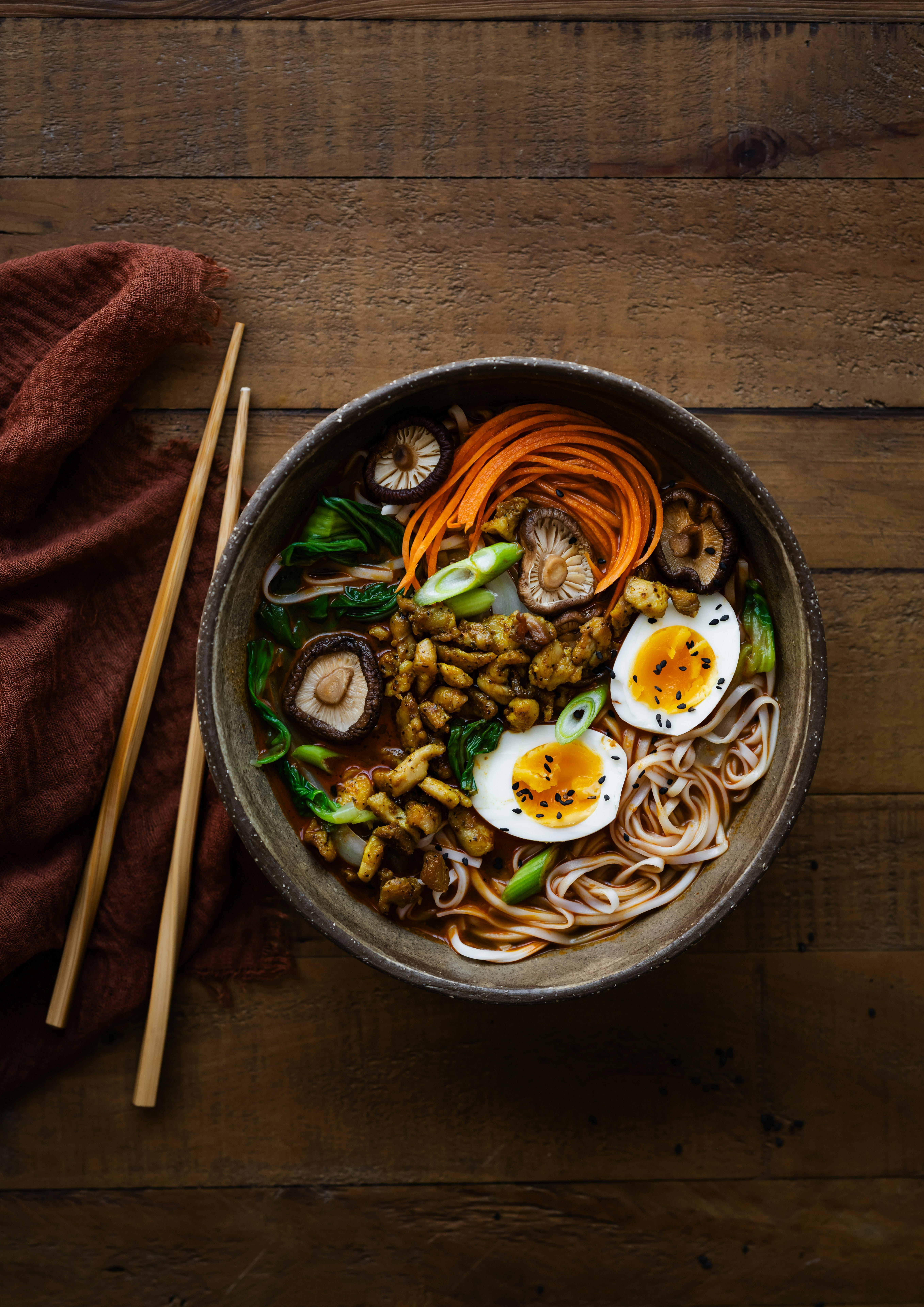
🍜 From Japan to 7-Eleven
Now, I know what you’re probably thinking: “That’s Japan. Here in the U.S., ramen comes from a foam cup, a packet of powder, and a dorm-room microwave.”
Trust me — I’ve been there.
Back in college, my roommate and I practically lived on 7-Eleven ramen. It was cheap, fast, and tasted amazing at 2 a.m. after a long day. But that convenience came at a cost. Those little bricks of noodles were loaded with preservatives, artificial flavors, and enough sodium to make your heart race before finals even started.
Here’s what’s actually hiding in a typical instant ramen packet:
Enriched bleached wheat flour, palm oil (often hydrogenated), monosodium glutamate (MSG), maltodextrin, hydrolyzed soy or corn protein, artificial beef or chicken flavor, Yellow #5 and other food dyes — plus a sodium load between 1,500 and 2,000 mg per pack.
A 2017 study in Nutrition Research and Practice found that frequent instant-noodle consumption was linked to significantly higher rates of metabolic syndrome — especially in women.
But here’s what most people don’t realize: there’s another kind of ramen.
Even in smaller towns, tucked between sushi spots and strip-mall restaurants, you can find traditional ramen made with real ingredients — slow-simmered broths, fermented miso, seaweed, mushrooms, and hand-cut noodles.
And it won’t break the bank. A quality bowl usually runs between $12 and $18 — cheaper than a steak, and arguably more nourishing if it’s made right.
💬 How I Use ChatGPT to Find Real Ramen (and Other Superfood Spots)
After going to one decent ramen place for a while, I started craving something more authentic — something that felt like stepping into a narrow Tokyo alleyway, not another Texas strip mall.
So I pulled up ChatGPT and ran a prompt I now use all the time:
“Find me a traditional Japanese ramen restaurant in Dallas that uses house-made bone or fish broth, kombu or kelp, avoids seed oils, and includes fermented ingredients like miso or chili paste. Bonus points if the chef has a cultural connection to Japan or it’s a small, founder-led place.”
That’s how I found Ichigoh Ramen Lounge — a hidden gem that checked every box. They make their own fish-based broth, include kombu and fermented pastes, and skip the industrial seed oils.
Now I use a similar prompt to find or vet restaurants of any cuisine — Mexican, Vietnamese, even pizza — and filter them through a biohacker lens. It takes five minutes and completely changes the dining experience.
🔧 Bonus Tools I Love
Seed Oil Scout — Maps restaurants that avoid inflammatory oils
Google Maps keyword stack — Try searching: “house-made broth,” “fermented,” “grass-fed,” “kombu,” “traditional recipe”
Why We Need to Rethink What “Healthy” Even Means
If minerals, collagen, omega-3s, and fermented compounds are some of the key nutrients missing from our modern diets — and if something as humble as ramen can deliver them — then why are we still being told that the path to health is paved with starvation diets, flavorless chicken breast, and $80 protein tubs?
That’s a topic for another day — but I can’t help thinking it has a lot to do with the culture we live in. A culture of comparison. Of fitness influencers and “clean-eating” trends that reward deprivation over joy.
You see someone on Instagram eating chicken breast and drinking a “fit tea,” and suddenly you’re thinking, Maybe I should do that too. Then you’re in the gym seven days a week, exhausted but convinced you’re chasing health.
It comes down to the culture of eating itself.
In Japan, meals are often shared around a table with family or friends, in the early evening, in a relaxed and present state. They eat slowly, together, without screens. They eat to connect, not to control.
And they eat with intention.
One of my favorite examples is the Okinawan principle of hara hachi bu — the practice of eating until you’re about 80% full. Not stuffed. Not starving. Just nourished (Miyagi et al., 2012).
Compare that to the Western habit of eating alone, standing over the sink, scrolling TikTok, or rushing through takeout in the car. One is nourishment. The other is a blood-sugar crash waiting to happen.
“We are not just what we eat — we are how we eat.” — Michael Pollan
Learning about this blew my mind — and completely changed how I see food.
Maybe true health isn’t about restriction or perfection.
Maybe it’s about remembering how to eat like a human again.

🌸 Final Thoughts
This whole journey started with one simple question over a bowl of ramen.
And what I found is that “healthy” isn’t about avoiding the foods we love — it’s about reclaiming how we eat and what we value in food.
So yes — ramen, when made with intention, can be one of the most nourishing meals you’ll ever have.
Because superfoods aren’t limited to kale or chicken and broccoli.
They’re found in all types of cuisines — if we care enough to look deeper.
Go out. Eat well. Eat with people you love. And enjoy your food.
With love,
Jack
📚 References
Charoensiddhi, S. (2023). Health-promoting bioactive compounds in edible seaweeds: A review. Marine Drugs, 21(3), 156. https://doi.org/10.3390/md21030156
Guggenheimer, J., et al. (2021). Bone broth consumption decreases proinflammatory cytokines IL-6 and TNF-α in murine models. Journal of Nutritional Biochemistry, 92, 108634. https://doi.org/10.1016/j.jnutbio.2021.108634
Harvard Health Publishing. (2021). The benefits of resistant starch for gut health and energy balance. Harvard Medical School.
Imai, S., et al. (2019). Nutrient composition and bioavailability of traditional braised meats. Nutrition Reviews, 77(5), 347–359. https://doi.org/10.1093/nutrit/nuy065
Miyagi, S., Imai, Y., & Kawamura, A. (2012). The Okinawan longevity diet and hara hachi bu: The practice of eating until 80% full. Asia Pacific Journal of Clinical Nutrition, 21(2), 144–150.
Pangestuti, R., et al. (2020). Bioactive compounds of yuzu (Citrus junos) and chili pepper (Capsicum spp.) in vascular and metabolic health. Frontiers in Nutrition, 7, 145. https://doi.org/10.3389/fnut.2020.00145
Pangestuti, R. (2021). Seaweed polyphenols and anti-glycation mechanisms for skin health and aging prevention. Marine Drugs, 19(10), 535. https://doi.org/10.3390/md19100535
Park, S., et al. (2017). Consumption of instant noodles is associated with cardiometabolic risk factors among Korean adults. Nutrition Research and Practice, 11(4), 306–312. https://doi.org/10.4162/nrp.2017.11.4.306
Tanisawa, K., et al. (2022). Role of seaweed-derived glutamates in digestion and metabolism. Food Chemistry, 383, 132394. https://doi.org/10.1016/j.foodchem.2022.132394
Veitch, D. P., et al. (2023). Docosahexaenoic acid (DHA) levels and brain structure in aging adults. Nutrients, 15(1), 48. https://doi.org/10.3390/nu15010048
Spot on. This is exactly how I feel! My Pilates practice taught me true health is about balance and feeling good, not just restriction.
Now include avoids MSG in the broth. The list will be empty save in Japan where one or two spots in all of Tokyo cater to those of us who can't go there