


My Story with Cortisol Burnout
I know because I lived it. When I was working in finance, I was running on nootropics and four cups of coffee before 2. I had a drawer full of supplements for focus, energy, and mood and felt really good for a couple hours.
But what I didn’t have was a single afternoon where I felt sharp past 2pm, or a single night where my brain actually switched off.
Most people call this “stress.” Or “burnout.” Or “adrenal fatigue.”
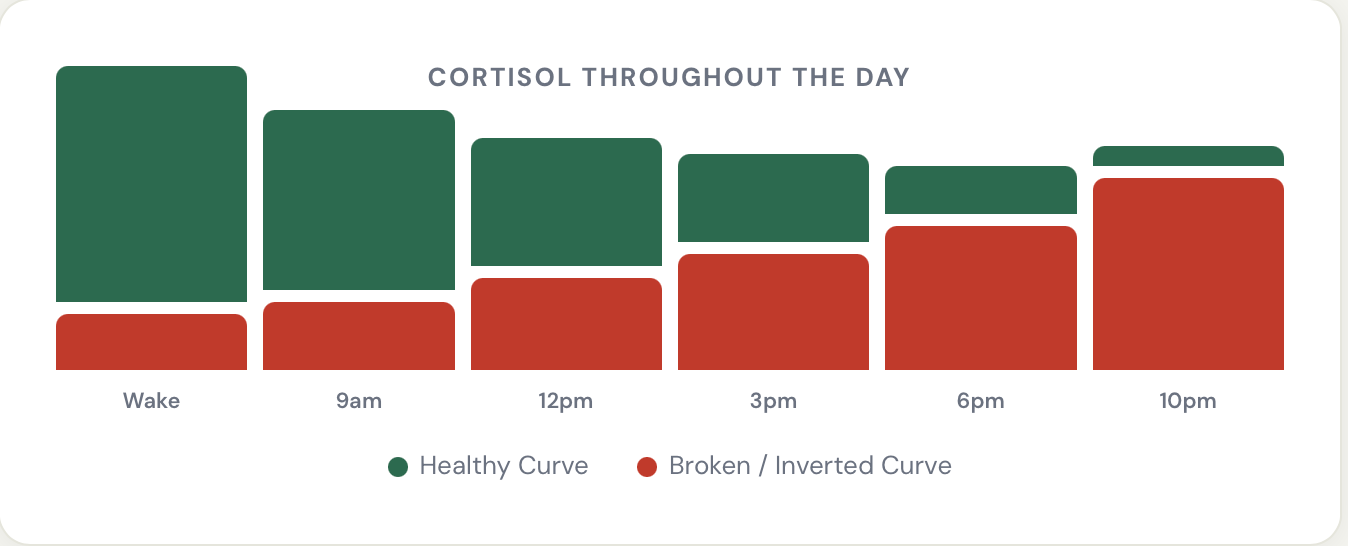
Turns out my cortisol curve was completely inverted. High when I needed to sleep, flat when I needed to perform.
Once I understood that, everything else clicked.
Here’s what’s actually happening, and the 4-step protocol to get your curve back.
What Your Cortisol Curve Is Actually Supposed to Look Like

Cortisol is produced by your adrenal glands and follows a diurnal rhythm — a natural rise-and-fall pattern tied to light, time, and your internal clock.
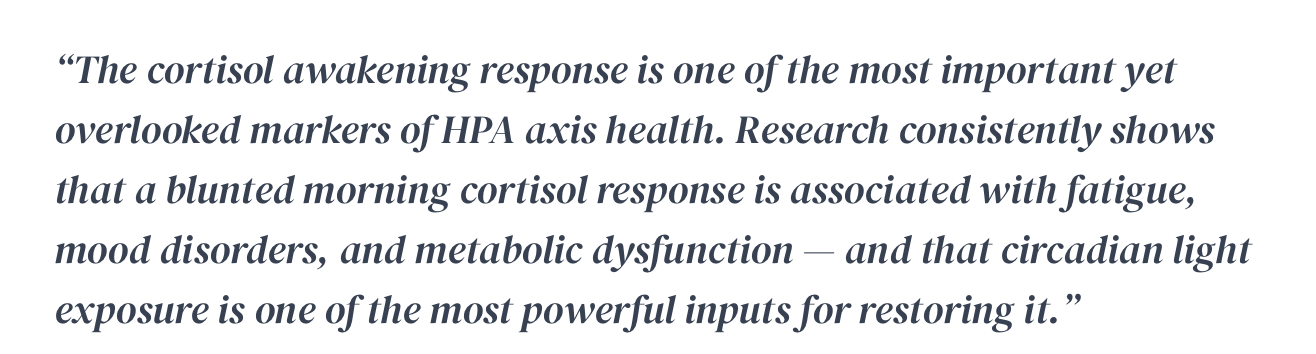
In a healthy person, cortisol spikes sharply within 30–45 minutes of waking.
This is called the Cortisol Awakening Response (CAR). It’s your brain saying: wake up, focus, go get it. Levels then taper steadily through the day and drop to their lowest around midnight, triggering melatonin and deep sleep.
Why Your Cortisol Curve Gets Wrecked
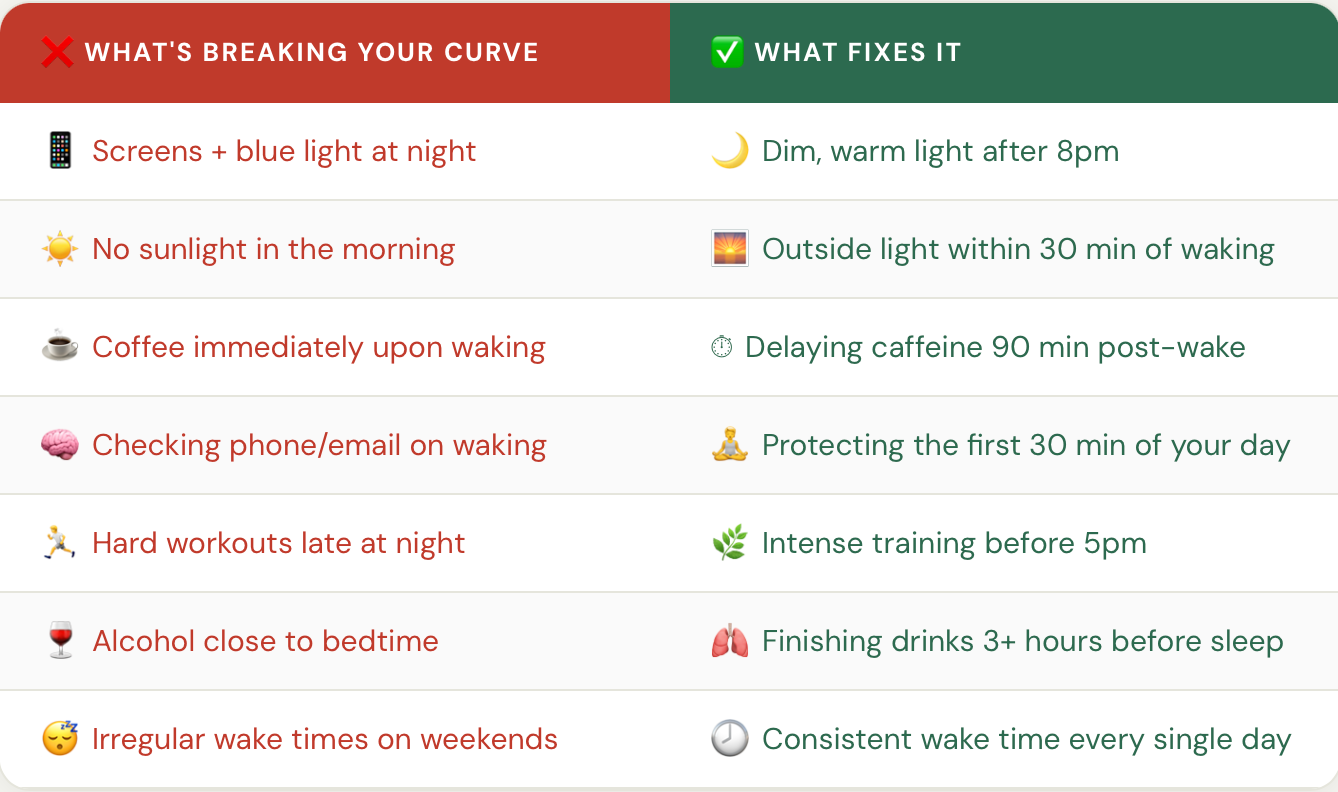
Cortisol dysregulation has predictable causes — most of which are 100% fixable with behavior, not prescriptions.
The 4-Step Cortisol Reset Protocol
This is the exact protocol I used to fix my sleep, my morning energy, and of course, the infamous 2pm crash.
1. Get Outside Light Within 30 Minutes of Waking
This is the single most powerful lever.
Sunlight hitting your retinas triggers a cascade that locks in your circadian rhythm, boosts your CAR, and tells every cell in your body what time it is. No sunglasses. 5–10 minutes minimum.
Do this even on cloudy days — outdoor light is still 10–50× brighter than indoor light.[2]
2. Delay Your First Coffee by 90–120 Minutes
If you drink coffee the moment you wake, you’re masking the CAR spike instead of building on it.
Wait 90 minutes, let cortisol do its job, then use caffeine to extend the focus window. You’ll feel the difference within days.
3. Protect the First 30 Minutes of Your Day
Do NOT check your phone within the first 30 minutes.
Every notification, email, and news headline is a cortisol trigger — but at random, reactive intervals. You’re not resetting your curve; you’re blowing it up.
That morning window is sacred. Use it for movement, light, breathing, or silence. Whatever grounds you.
4. Create a Hard Stop on Blue Light After 9pm
Your brain reads blue light as daylight. Keep it on after dark and your cortisol won’t drop — it stays elevated, melatonin gets suppressed, and your sleep architecture fragments.
Warm lights, red light panels, or blue-light-blocking glasses after 9pm. Not perfect compliance. Just consistent enough to signal the transition.
Layer In the Supplements (Once the Habits Are Locked)
Here’s the thing about adaptogens and cortisol supplements — they work best when your lifestyle isn’t fighting them.
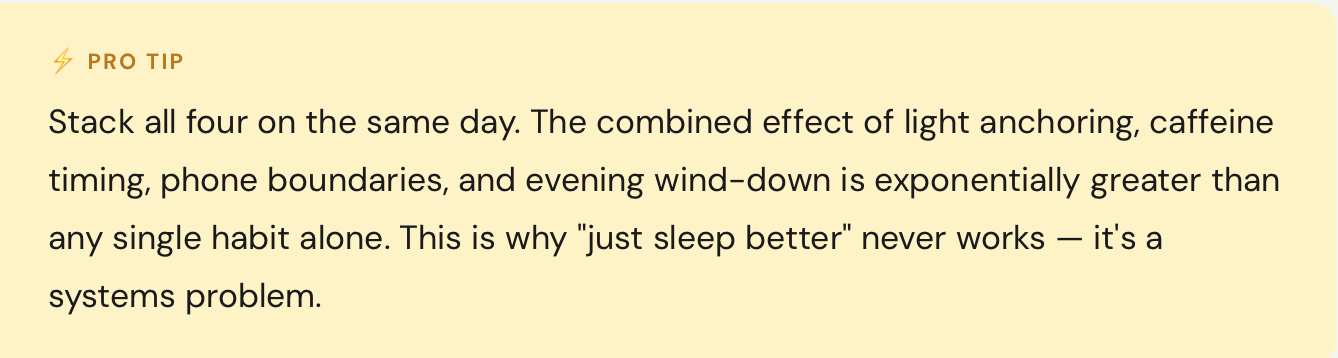
Lock in the four habits first. Then layer these in.
1. Magnesium Breakthrough by BiOptimizers — a 7-form magnesium blend that genuinely moves the needle on sleep depth and morning recovery. I take it every night. Get it here.
2. Organifi Gold — ashwagandha, reishi, and turmeric in one evening drink. It’s become part of my actual wind-down routine. Get it here.
3. BiOptimizers Sleep Breakthrough — I use the cherry flavor. It’s a powdered sleep drink that supports deep sleep and HPA axis recovery. This is the one I reach for when habits alone aren’t cutting it. Get it here.
How to Know If Your Curve Is Actually Improving
You don’t need labs to feel the shift. Here’s what a correcting cortisol curve feels like in real life:
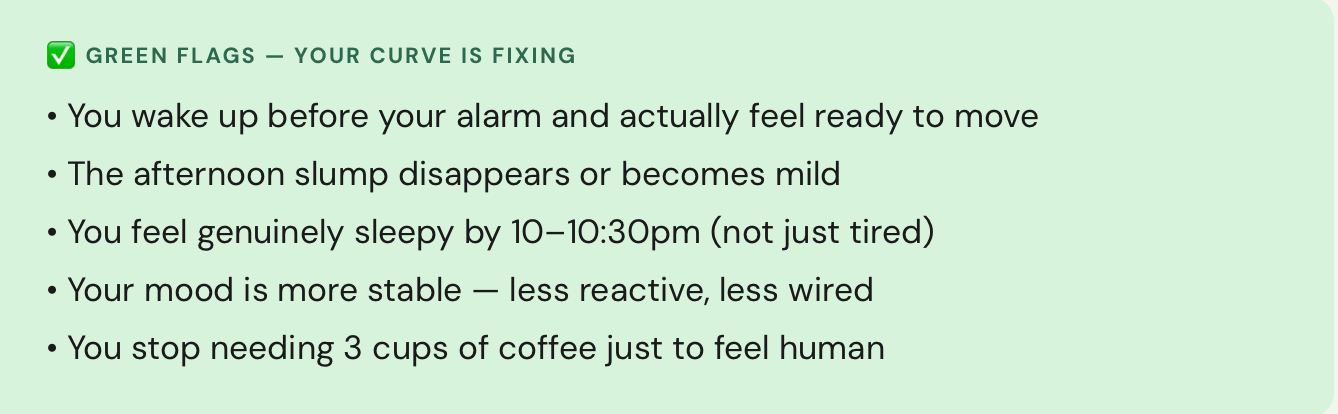
If you want the data, a 4-point salivary cortisol test (morning, noon, afternoon, evening) will show your curve in black and white. DUTCH testing is the gold standard.
Ask a functional medicine or integrative medicine practitioner — use IFM's directory to find one near you.
The Bottom Line
Cortisol isn’t your enemy. It’s your most powerful performance hormone — when it shows up on time.
The people who go through life dragging, crashing, and reaching for stimulants every three hours aren’t lazy. Their biological clocks are running on the wrong schedule. That’s a fixable systems problem, not a character flaw.
You don’t have to quit going out. You don’t have to become a monk. You just have to give your body the right timing signals — morning light, delayed caffeine, a protected first hour, and a real wind-down at night.
Start with one. Nail it for a week. Then add the next. The compound effect hits faster than you’d expect.
References & Sources
Stalder T. et al. (2016). "Assessment of the cortisol awakening response: Expert consensus guidelines." Psychoneuroendocrinology, 63, 414–432. PubMed PMID: 26748791 — confirms cortisol rises 50% or more within 30 min of waking in healthy adults.
Institute for Functional Medicine. "What Do Cortisol Curves Tell Us About Health?" ifm.org — confirms normal diurnal pattern peaks in morning and bottoms at night; flatter curves associated with negative health outcomes.
Roberts A.D. et al. (2004). "Salivary cortisol response to awakening in chronic fatigue syndrome." The British Journal of Psychiatry, 184(2), 136–141. PubMed PMID: 14754825 — confirmed blunted CAR in CFS patients vs. healthy controls.
Patel R. et al. (2025). "An Integrative Approach to HPA Axis Dysfunction: From Recognition to Recovery." The American Journal of Medicine. PubMed PMID: 40499704 — peer-reviewed integrative medicine review of HPA dysregulation, diagnosis, and treatment.
Institute for Functional Medicine. "Lifestyle Changes for Shifting Cortisol Levels." ifm.org — exercise, forest bathing, and lifestyle interventions for cortisol regulation.
Huberman Lab Podcast. Andrew Huberman, Ph.D., Stanford. Episode: "Using Light to Optimize Health." Discusses morning light exposure and its effect on the CAR and circadian rhythm entrainment.
This content is for educational purposes only. It does not constitute medical advice and is not a substitute for consultation with a qualified healthcare practitioner.
Jack is an independent health coach and does not diagnose, prescribe, or interpret lab results. If you suspect HPA axis dysfunction, consult a licensed functional medicine practitioner — find one at IFM's directory.