

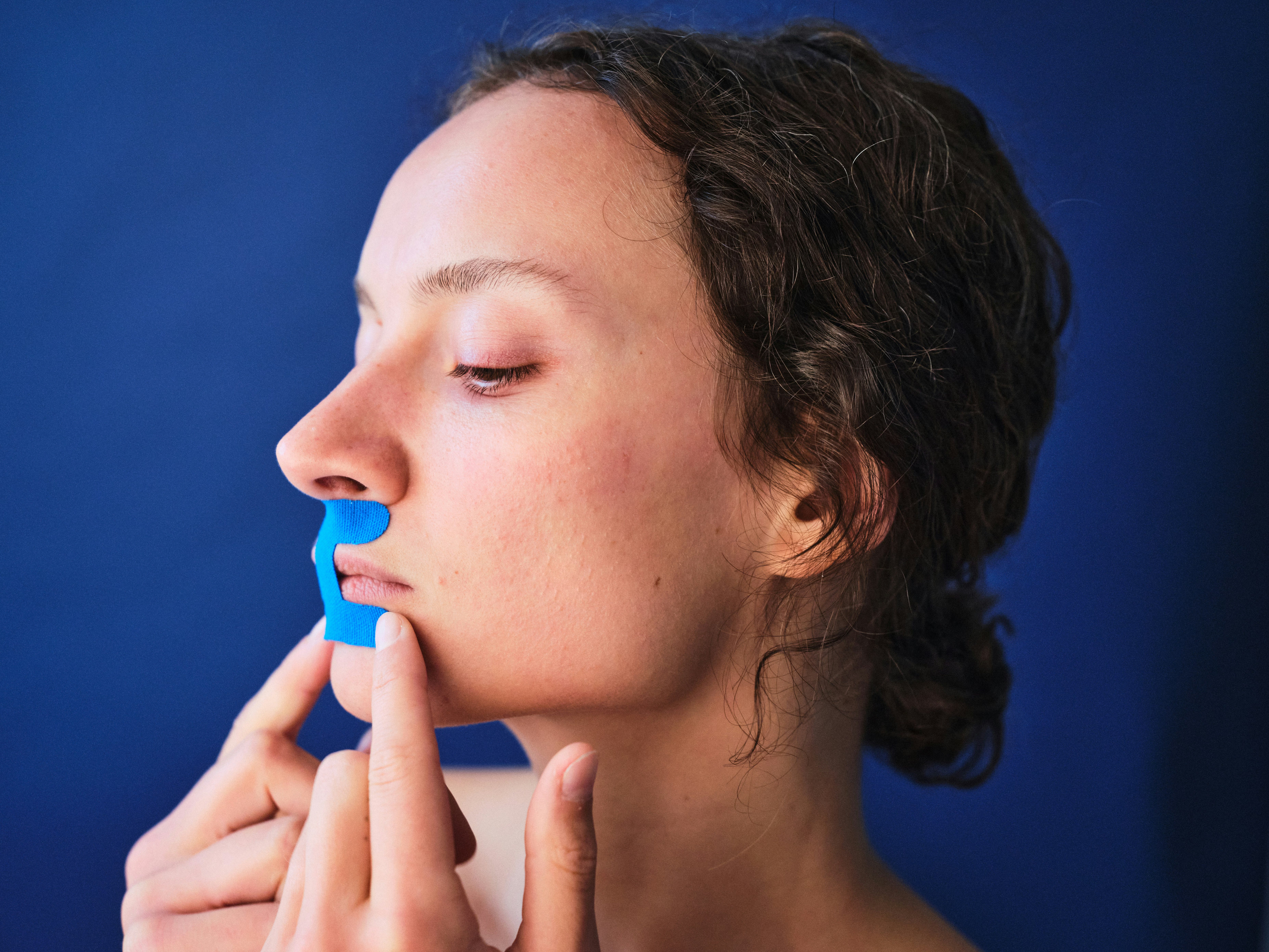
One of my friends wears a nose strip during work.
First time I met him, I said, “Yo—you’re a biohacker! When did you start wearing nose strips?”
Turns out he has a deviated septum and uses the strips just to “actually feel like I’m breathing during the day.”
That hit home.
My little brother Ben had a deviated septum most of his life. He was constantly on medications, eventually needing surgery. I remember watching him struggle to sleep—always stressed, always low energy. The dude couldn’t enjoy life because he literally wasn’t getting enough oxygen.
Funny enough, Ben was actually the OG biohacker in the family. He was the first person who ever introduced me to mouth taping. One night, I stumbled into his room and saw him sleeping with a piece of tape across his mouth. I figured it was just one of his weird beauty hacks (he used to follow those obscure looksmaxxing forums trying to get a better jawline).
But he was onto something.
The theory was simple: Nasal breathing at night can help restore facial symmetry and optimize breathing patterns. Mouth tape forces you to breathe through your nose, while nose strips let more air in—allowing more oxygen into the body.
I didn’t think much of it until years later when I noticed athletes like Carlos Alcaraz—one of the best tennis players in the world—wearing nasal strips during tournaments. Then I saw Iga Swiatek, one of the top women’s tennis stars, taping her mouth during practice.
Suddenly, nasal breathing wasn’t just a “beauty hack.” It was becoming a performance strategy.
What started as a medical fix for a deviated septum… became a beauty trick… then an elite performance tool.
Now? It’s one of the best biohacks I’ve ever tried.
Here’s what’s coming up:
First—we’ll break down mouth tape: why it works, why you should breathe through your nose at night, and why nasal breathing during the day is just as critical.
Then—we’ll get into nasal optimization: how to open your nasal passages, what tools actually work (strips, tape, bands, and even those devices that make you look like you’re wearing a nose ring), and what gives the biggest oxygen advantage.
Why Mouth Breathing Wrecks You
So let’s begin by talking about the importance of nasal breathing and why mouth breathing is bad for you.
Nasal breathing is important—and necessary—because our nose is the only breathing apparatus in our body. Not the mouth.
In fact, the mouth was never supposed to be used for breathing. It was meant for eating, talking, kissing, biting people’s ears like Mike Tyson, and much more. The nose was developed for breathing, with all the proper tools built right into it.
The nose has capillaries for filtering air, produces nitric oxide for better oxygen absorption, mucus to humidify the air—and much more. Our bodies made the nose for breathing.
But over time, some of our genetics became obstructed. Our nasal passages and jaw formations became more rigid and disfigured.
This might be thanks to toxins in our environment or nutrient deficiencies—there’s a lot of science out there about why we began to develop these facial issues. Something researchers like Catherine Shanahan and Weston A. Price talk about in their books. (links down below)
But let’s just say—we lost our ability to regularly breathe through the nose.
Which means the body said: OK, the nose can’t breathe that well. Let’s focus on the mouth.
So now we have chronic mouth breathing. And that leads to a whole host of issues.
When You Mouth Breathe for Too Long, Bad Stuff Happens:
1️⃣ Dental and Oral Health Issues
I know a girl who had seven cavities at her last dentist visit—And she doesn’t even eat that much sugar. Turns out her bad mouth breathing habit at night caused it.
Mouth breathing reduces saliva production, leading to a dry oral environment. Saliva is essential for neutralizing acids and protecting against tooth decay.
No saliva = more cavities, cracked lips, tooth decay, and gum disease.
2️⃣ Postural and Musculoskeletal Effects
When your mouth stays open—whether you’re sleeping or just sitting at work—your head often shifts forward to open the airway.
Over time, this can lead to:
Forward head posture
Tight neck muscles
Chronic pain in the shoulders and upper back
TMJ pain (jaw dysfunction)
That’s why a lot of mouth breathers have tight neck muscles, stiff traps, and jaw problems.
(Temporomandibular Disorders and Mouth Breathing) (Posture and Airway: PMC)
3️⃣ Facial and Skeletal Development
Mouth breathing weakens the muscles that shape your face.
Prolonged mouth breathing has been linked to:
Craniofacial muscle imbalances
Changes in head posture
Altered pulmonary function
Deformation of the airway and jaw (PMC)
This happens in adults too. But even more importantly—it can seriously affect children.
Chronic mouth breathing in kids can lead to:
Elongated faces
Narrow jaws
Dental malocclusions
Poor tongue posture
(Orthodontic Effects of Mouth Breathing)
Although you might not be a kid, this is good to know for your children—or future children.
4️⃣ Cognitive and Neurological Effects
Mouth breathing has been linked to:
Decreased oxygen saturation in the brain (ScienceDirect)
Impaired memory, attention, and learning
Altered brain activity patterns
Increased stress
Learning difficulties (ScienceDirect)
Speech impediments (like lisps)
If you’re feeling foggy or struggling with focus, this might be one of the root causes.
5️⃣ Sleep and Respiratory Disturbances
Mouth breathing at night leads to:
Poor sleep quality
Snoring
Sleep apnea
Less restorative sleep
Daytime fatigue
Mood swings
Weaker memory consolidation
(Sleep Apnea and Mouth Breathing)
If you ever wake up tired after what “should have been enough sleep”—mouth breathing could be a big part of the reason.
Oxygen is everything in the body. And when we don’t have enough of it, all the nootropics and supplements in the world won’t save us.
Mouth Taping 101
So how do we fix our chronic mouth breathing? It starts with a little piece of tape.
I first learned about mouth taping through my brother Ben—the OG biohacker in the family. He was deep into those looksmaxing forums where guys were trying every method to improve facial symmetry.
Their theory was simple: Mouth breathing → low tongue posture → weak jawline.
They found that mouth taping at night forced the tongue up and supported the upper jaw (maxilla) while preventing bad oral posture.
At first, I thought he was crazy. Why are you taping your mouth? Wouldn’t you suffocate?
Then I learned about the benefits —and felt the difference myself.
Benefits of Mouth Taping
1️⃣ Better Deep & REM Sleep
When I first tried mouth taping, I was shocked at how refreshed I felt the next morning.
By forcing nasal breathing, you improve oxygen utilization and achieve deeper, more restorative sleep.
Bonus: No more snoring. (Sleep and Nasal Breathing Research)
2️⃣ More Energy
More oxygen = more cellular energy (ATP).
3️⃣ Fewer Cavities & Oral Issues
I now wake up with little to no bad breath. By keeping your mouth closed, saliva production stays healthy, maintaining the proper pH balance.
4️⃣ Enhanced Facial Features
The looksmax guys were onto something. I swear my jawline has improved dramatically over time.
5️⃣ Better Blood Flow
Nasal breathing promotes nitric oxide production, which supports circulation (Nitric Oxide PMC).
6️⃣ Improved Focus & Cognitive Function
Better breathing = better brain oxygenation = sharper thinking (ScienceDirect).
7️⃣ Metabolism Boost
Proper oxygen utilization helps regulate metabolic rate (Breath by Nestor).
8️⃣ Better Performance (Workouts, Sex, Sports)
Athletes have started adopting nasal breathing strategies because oxygen efficiency is a game changer.
9️⃣ Immune Support
Nasal breathing filters pathogens and supports immune defense (PMC Respiratory Immunity).
“Will I Suffocate?”
Probably the biggest question I get.
No—you won’t suffocate. If you are heavy mouth breather, the first night might be difficult but over time you will begin to nasal breathe again and feel amazing.
Safety is paramount though. Make sure your nasal passages are clear before trying mouth taping.
If you have:
Serious nasal obstructions
Allergies
Sleep apnea
Consult a healthcare professional first.
Can I Use Regular Tape?
Please don’t. I will give you links down below for the best ones to use.
Nasal Optimization (Nose Strips & Tools)
So nasal breathing is the best way to feel amazing and live long, happy lives—and mouth taping can help us big time.
But how could we make it even better?
Introducing Nasal Optimization.
(By the way, I think I made this phrase up. Might be a genius? Someone probably said it first... but let me cook! Comment down below.)
By opening up your nasal passages using either nose strips or a dilator, we can breathe even better—allowing more oxygen into the body.
More oxygen means:
✅ Sports Performance → Oxygen efficiency supports endurance, strength, and mental sharpness under pressure.
✅ Daily Energy & Focus → Better oxygen delivery improves sustained attention, reduces fatigue, and enhances productivity.
✅ Longevity → Nasal breathing lowers systemic stress, supports nitric oxide production, and promotes cardiovascular and metabolic health.(Nitric Oxide PMC)
This is why you see some of the greatest athletes and visionaries in the world using these tools.
I was blown away when I saw Carlos Alcaraz come out with a nose strip during the 2024 ATP Finals in Turin, Italy. Facing respiratory issues from a cold, he wore a pink nasal strip in his match against Andrey Rublev on November 13, 2024.
Alcaraz credited the strip for aiding his breathing and enhancing his performance:
"For me, it helped a lot today. I could breathe much better."
He continued using the nasal strip into 2025, wearing a black version during the Rotterdam Open in February. Even after recovering from his illness, he kept wearing it—calling it a superstition, but I think we all know it was really about the oxygen advantage. Would it be superstition for Casper Ruud, too—who began wearing a nasal strip Or superstition for Iga Swiatek?
Nah. They know how amazing it is.
Casper Ruud first bought nasal strips to relieve nighttime congestion during Norway’s brutal winters. Surprised by how well they worked, he started using them during practice and matches:
“I thought, why not try to bring it to practice? It feels like I'm breathing better, so just a few percentage extra of oxygen through the nose—that's what it's about. For me, it works. Maybe it's a placebo or whatever, but I feel like it works.”
— Casper Ruud
Because when you're trying to win the match—and it's the fifth set, the fifth hour—you need every small yet dramatic edge.
And I would be remiss not to mention, one of the most popular entrepreneurs today, Alex Hormozi. He has made nose strips astronomically popular after promoting them for fixing his snoring issues and increasing his productivity.
🛠️ Where to Get Nasal Tools & How to Start
Ready to breathe like a pro? Here’s exactly how to start using nasal tools.
🔹 Best Nasal Strips
Breathe Right Extra Strength → Widely available, easy to use, and strong hold. (Amazon)
Hostage Nasal Strips → I enjoy these ones a lot. (Amazon)
🔹 Best Nasal Dilators
Mute by Rhinomed → Comfortable internal dilator, adjustable sizes. (Mute)
🔹 New Tech / Advanced Options
Intake Breathing Bands → Small magnetic bands that clip to your nose for a sleek look. Athletes love them for a less bulky alternative. (Intake)
🏁 How to Start with Nasal Optimization.
Step 1: Test a Nasal Strip and Mouth Tape at night.
Try a simple Breathe Right strip and a piece of mouth tape at night. Notice how you feel once you wake up and your energy throughout the day.
Step 2: Experiment with Dilators
If strips feel limiting or you want even more airflow, test an internal dilator like Mute or Airmax.
Step 3: Use During Key Moments
Mouth tape for Sleep → Better rest, less snoring.
Dilatos for Workouts → Boost endurance and focus.
Dilators and even tape during Deep Work / Productivity → Like Hormozi, use them to maintain brain oxygen during long work sessions.
Step 4: Build the Habit
Most people feel awkward at first. After 3–5 days, you won’t want to go without them.
📝 Pro Tip:
If you’re really congested or have chronic nasal blockages, consider seeing an ENT or nasal breathing specialist first.
🧘 Other Ways to Improve Nasal Airflow
While nasal strips and dilators are easy tools to start with, there are other powerful ways to open up your nasal passages and improve airflow naturally:
🔹 Yoga & Breathwork
Yoga: Certain poses (bridge, fish, child’s pose) can help open the chest and nasal passages.
👉 Breathe & Flow YouTube (great for yoga routines focused on breath and posture)
Breathwork: Techniques to strengthen nasal breathing, CO₂ tolerance, and calm the nervous system.
👉 Breathe with Sandy YouTube (my personal favorite for accessible breathwork practices)
🔹 Posture & Chiropractic Adjustments
Chiropractic care and structural integration can improve neck position, jaw alignment, and rib cage expansion.
In Dallas: 👉 I personally work with Dr. Mark Currington at Dallas Lifestyle Management Clinic. He does Nasal cranial resets that are amazing for breathing better.
To find someone near you, search for structural chiropractors or chiropractors focused on ‘Chiropractic Biophysics’ techniques.
📚 Resources & Further Learning
Your airway, jaw, and nasal structure are hugely impacted by nutrition, especially early in life.
Dr. Catherine Shanahan → Author of Deep Nutrition, shows how traditional diets support stronger jaw and airway development. Dr. Cate’s Website
Weston A. Price → His book, Nutrition and Physical Degeneration, is essential reading if you want to understand why modern diets have changed our facial structure. Weston A. Price Foundation
Breath by James Nestor → The modern guide to nasal breathing, mouth taping, and airflow optimization. Book Link
The Oxygen Advantage by Patrick McKeown → Book Link
ButeykoClinic.com → Visit Site
🏁 Conclusion
From seeing my friend wear a nose strip out in public… To watching my brother sleep with tape on his mouth… To becoming a full-blown nasal optimization and mouth tape guy myself—I’m hooked.
This simple practice has helped me in so many ways.
Better sleep. More energy. Sharper focus. Even better facial structure over time.
Try it for yourself:
Start with mouth tape at night and a nasal strip.
See how much better your sleep and energy feel.
If you work from home, throw on a nasal strip during deep work or workouts.
Then let me know how it goes.
Breathing better changed my life—and it might change yours too.
Love you all.
I’m grateful to my partners who create amazing health & wellness products.
Disclaimer. I am not a doctor. This is just some random stuff I learned on the internet. Pretend it’s a story. Ok bye.
Question: how do you know you’re a mouth breather?
I’ve been using mouth tape when I sleep for about a year and it’s a total game changer. Can’t go without it now.
I’ve tried nasal strips but they haven’t stuck for me (pun intended). Might try the Intake bands or one of the nasal dilators though.