


Here is something I got wrong for years as a health-conscious shopper: buying organic does not mean pesticide-free.
The green USDA Certified Organic label is easy to trust. It costs more, it looks official, and it feels responsible.
What it does not tell you is that it permits up to 25 synthetic pesticides plus additional naturally derived chemicals.

I spent years buying all-organic everything because I believed the label meant safe. All I wanted was food that was actually free of toxic chemicals, so I went looking for real answers.
By the end, you will have a clear, simple way to reduce 90 percent of pesticides in your diet starting with your next grocery run.
Does Organic Mean Pesticide-Free? Not Exactly.
If you have ever Googled “does organic mean pesticide free,” you are not alone.
It is one of the most searched food questions online, and the answer surprises most people.
Organic is better. Significantly better. But it is not clean.
Research from Consumers Union found that organic produce carries roughly one-third the pesticide residues of conventionally grown food. That is a real difference worth paying for. But one-third is not zero.
Here is what most don’t know about USDA Certified Organic:
It permits up to 25 synthetic pesticides plus a longer list of naturally derived chemicals
There are actually three different organic labels. “100% USDA Organic” means all ingredients are certified organic. Plain “USDA Organic” means only 95 percent are. “Made with Organic” means just 70 percent
Despite overseeing a $43 billion industry, the USDA organic division has only five compliance officers
So when you ask “is organic food actually pesticide free,” the honest answer is no.
And there is a problem no amount of washing solves.
Some pesticides are systemic, meaning the plant absorbs them through its roots directly into the flesh of the fruit or vegetable. Consumer Reports confirmed that rinsing only removes surface residue.
For systemic pesticides, the exposure is already inside the food before it ever leaves the farm.
What Do Pesticides Do To Your Body?
According to CDC testing, the average American carries roughly 13 different pesticides in their body at any given time. That number includes people who eat organic.

The National Institute of Environmental Health Sciences Agricultural Health Study linked pesticide exposure to Parkinson’s disease, thyroid disease, diabetes and kidney disease, among other conditions.
The damage shows up across nearly every system:
Gut: A 2023 study found exposure to insecticides and fungicides was consistently associated with decreased bacterial diversity and significant changes in 39 different bacterial species
Hormones: The Endocrine Society found that glyphosate, the world’s most widely used herbicide, displays eight of ten key characteristics of an endocrine-disrupting chemical
Brain: Research has linked pesticide-induced gut disruption during critical windows of brain development to autism spectrum disorder
Autoimmune: An 18-year study found one specific pesticide compound was tied to a 70 percent elevated risk of rheumatoid arthritis
How to Reduce Pesticide Exposure
You cannot eliminate pesticide exposure completely. That is not the goal.
The goal is meaningful reduction, and the research shows it is possible faster than most people think.
After getting sick and spending over $50,000 trying to figure out what was destroying my health, pesticide exposure turned out to be a major piece of the puzzle. Now I research this obsessively so you do not have to.
Here is the exact system I use every time I walk into a grocery store.
1. Look for the Regenerative Organic Certified Label
USDA Organic is the floor. Regenerative Organic Certified is the ceiling.
ROC requires USDA Organic as a baseline, then goes further. Zero synthetic pesticides verified at the farm level. Cover cropping, no-till soil practices, and fair wages for farmworkers. It is the most rigorous food certification in the United States, and over 1,000 products now carry it.
The bonus most people do not know: a 2022 peer-reviewed study found regenerative crops had 50 percent more zinc and magnesium and 60 to 70 percent more antioxidants than conventionally grown crops. More nutrients means more flavor. More flavor means more value per dollar.
What to look for in the store:
The brown and green ROC badge on the front of the package
Best categories: grains, rice, cooking oils, chocolate, coconut products
Brands carrying it: Dr. Bronner’s, Patagonia Provisions, Lundberg Family Farms, Alter Eco, Lotus Foods
Full brand directory: regenorganic.org
Can’t find it? Fall back to USDA Organic plus the Glyphosate Residue Free seal, which we cover next.
2. Look for the Glyphosate Residue Free Label
Glyphosate has been detected in the urine of 93 percent of Americans tested. It gets into organic food through soil drift and supply chain contamination. The USDA organic label does not test for it. This one does.
Run by the Detox Project, GRF tests the actual finished product at least three times per year using gold standard lab testing, including a breakdown metabolite most certifications miss entirely.
One thing worth knowing: GRF only tests for glyphosate. Organic plus GRF together is the gold standard.
What to look for in the store:
A small circular Glyphosate Residue Free badge on the front of the package
Best categories: oats, protein powder, grain-based supplements, flour, cereals
Brands carrying it: MegaFood, Truvani, Perfect Supplements, AGN Roots, One Degree Organics, Jovial Foods, Nutiva
Thrive Market has a dedicated GRF section: shop it here
Full certified product directory: detoxproject.org
Next up: where to spend and where to save on produce using the most trusted pesticide testing list in the country.
3. Research The Dirty Dozen and Clean Fifteen
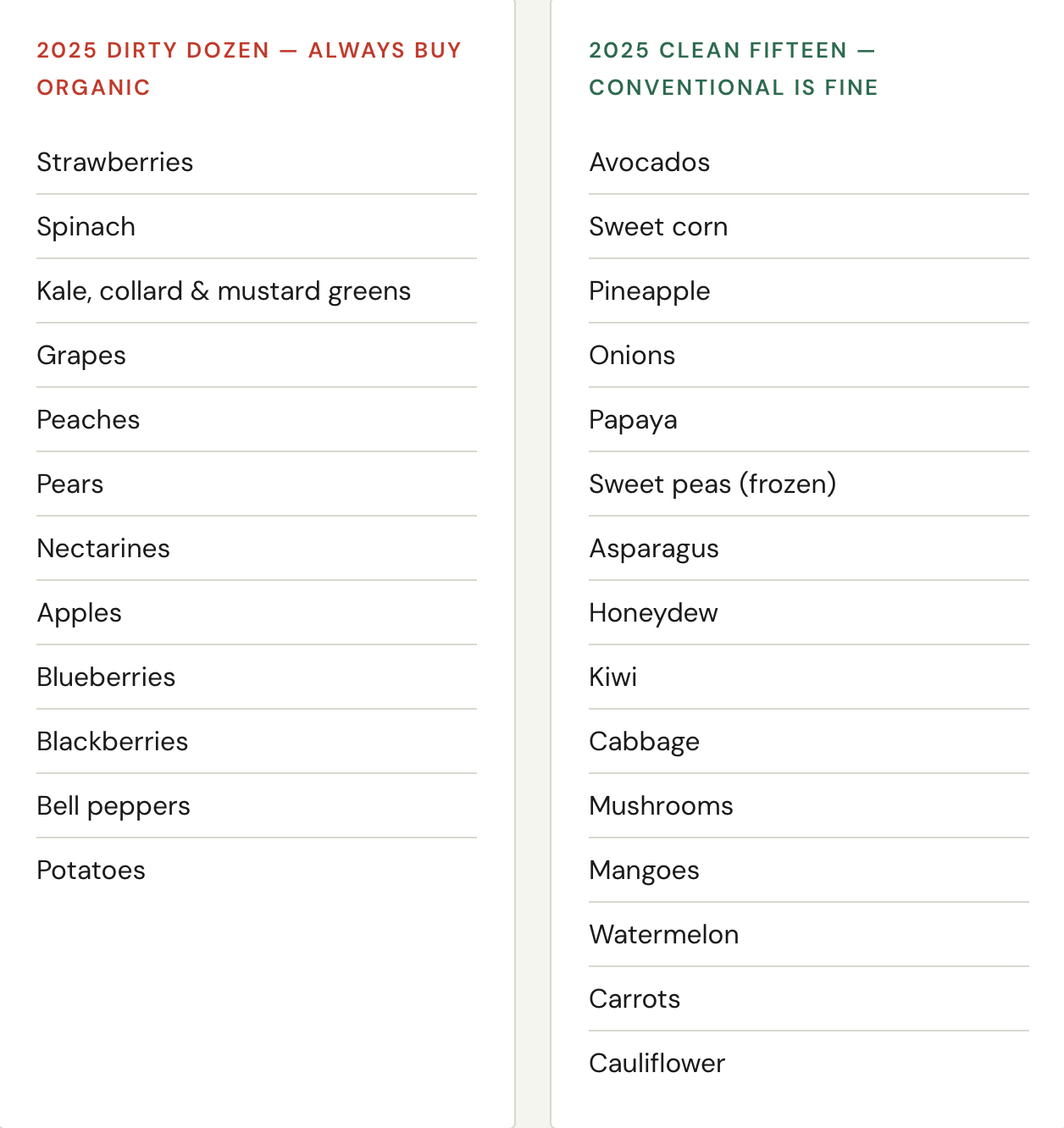
The Environmental Working Group tests over 53,000 samples every year and publishes two lists. Use them every time you shop.
Always buy organic — highest pesticide load: Strawberries, spinach, kale, grapes, peaches, pears, nectarines, apples, blueberries, blackberries, bell peppers, potatoes
Lowest pesticide load — organic less urgent: Avocados, sweet corn, pineapple, onions, papaya, sweet peas, asparagus, honeydew, kiwi, cabbage, mushrooms, mangoes, watermelon, carrots, cauliflower
Pro tip: Frozen organic Dirty Dozen items cost 40 to 60 percent less than fresh with identical benefits.
Full updated list: ewg.org
4. Shop Your Local Farmers Market
Many small farmers grow completely pesticide-free but cannot afford USDA Organic certification, which costs thousands of dollars a year.
The food is just as clean. It just does not have the label.
The payoff here is unique: you can ask directly. No other food source gives you that.

Find clean farms near you:
Nearest farmers market: ams.usda.gov/local-food-directories/farmersmarkets
Certified Naturally Grown farms: cngfarming.org
Farms, CSAs and markets by zip code: localharvest.org
Last step: wash everything, even the cleanest food you can find.
5. How to Remove Pesticides From Fruits and Vegetables
Washing produce does work. But how you wash it matters more than most people realize.
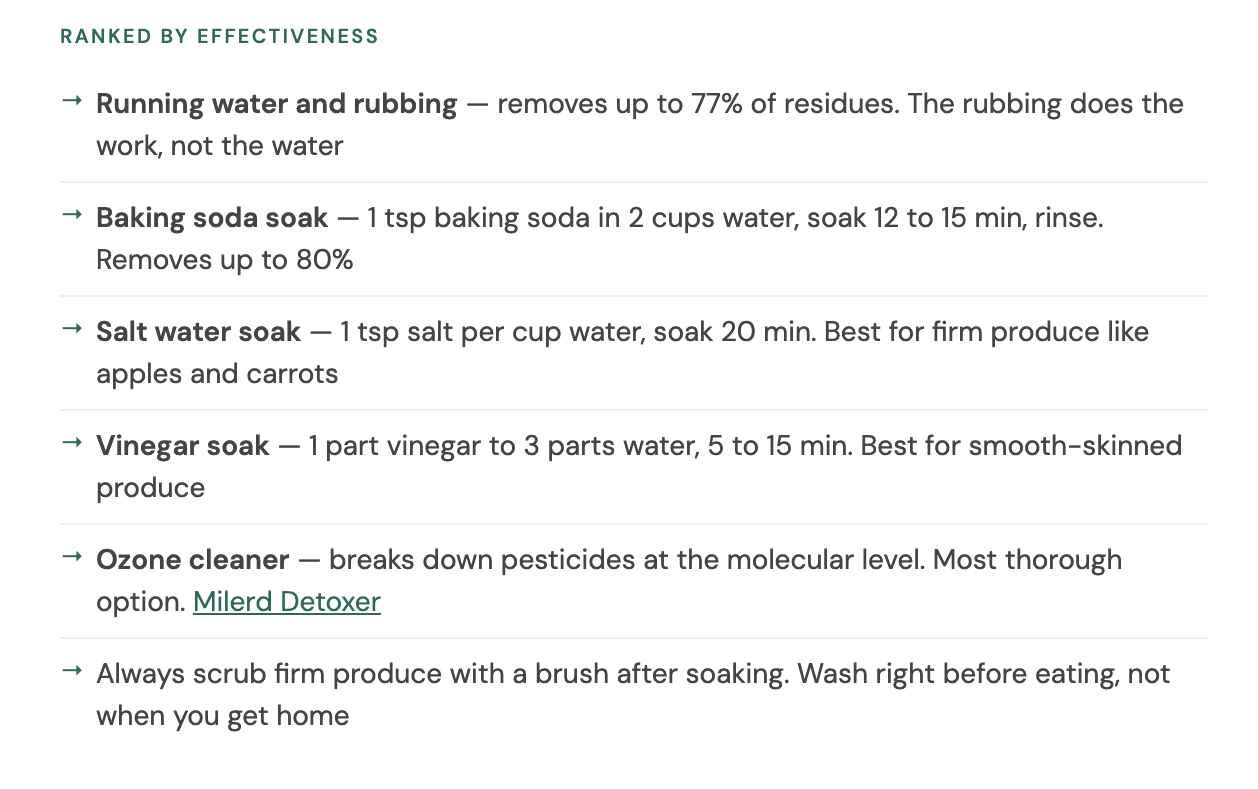
Here are the four most effective methods ranked by research, from easiest to most thorough. Pick one and use it every single time.
Method 1: Running Water and Rubbing (quickest) Research found that rubbing produce under running water removes up to 77 percent of pesticide residues, making it one of the most effective household methods tested. The mechanical action of rubbing is what does the work, not the water alone. Thirty seconds of active scrubbing beats two minutes of passive rinsing every time.
Method 2: Baking Soda Soak (best for most produce) A University of Massachusetts study found a baking soda soak removes up to 80 percent of surface pesticide residues. Mix 1 tsp baking soda in 2 cups of water, soak 12 to 15 minutes, then rinse under cold running water.
Method 3: Salt Water Soak (best for firm produce) Researchers found a salt water solution effective at removing common pesticide residues. Mix 1 tsp salt per cup of water and soak for 20 minutes, then rinse thoroughly. Works especially well for apples, carrots and potatoes.
Method 4: Vinegar Soak (best for smooth skinned produce) Mix 1 part vinegar to 3 parts water and soak for 5 to 15 minutes. The acetic acid helps dissolve pesticide residues. Rinse well afterward as vinegar can affect taste.
Method 5: Ozone Cleaner (most thorough) Ozone breaks down pesticides at the molecular level, reaching residues that water cannot. Fill a bowl, drop in the Milerd Detoxer, run a 15 minute cycle. The most thorough option for Dirty Dozen items.
One honest note: washing removes surface residues only. Systemic pesticides absorbed through the root system cannot be washed off. That is why sourcing matters first and washing is the final layer of defense.
Your Pesticide Reduction Plan: Start Here
You do not need to do everything at once. Pick one step this week and build from there. Every swap you make means less chemical load on your gut, your hormones, and your nervous system.
Buy organic on the Dirty Dozen, lowest pesticide load options on the Clean Fifteen
Look for the Glyphosate Residue Free seal on oats, protein powder, and grain-based supplements
Seek out Regenerative Organic Certified when you can find it
Ask one question at your farmers market this weekend
Wash everything with baking soda, salt water, vinegar, or an ozone cleaner before you eat it
The Bottom Line:

The average American carries 13 or more pesticides in their body right now. Most of them got there through food. And most of them can be dramatically reduced, not through perfection, but through better information.
You now have that information.
Here is what you walked away with today:
The USDA Organic label is a good start, not a finish line
The Glyphosate Residue Free seal and Regenerative Organic Certified label are the gold standard
The Dirty Dozen tells you exactly where to spend and where to save
Your local farmers market may have the cleanest food in your city with no label at all
Washing the right way removes up to 80 percent of what is left
None of this requires a bigger grocery budget. It requires a smarter one. You do not need to overhaul your entire life this week. Pick one thing from this article, do it on your next grocery run, and build from there.
The people who feel the best, think the clearest, and age the slowest are not eating perfectly. They are just making slightly smarter decisions at the grocery store, at the farmers market, and at the kitchen sink than everyone else around them.
That is all this is. Slightly smarter, compounded over time.
Your body will notice. Faster than you think.
Have a great one guys,
Jack (Founder of Biohack with Jack)
Wow this is a banger. No one really talks about how much better organic apples really are tho