

I’ve always had trouble understanding why people hate creatine so much.
On one hand, you’ve got the fans.
Scientists, sports doctors, athletes, and biohackers all love it—not just for its muscle and performance benefits, but also for its potent neuroprotective effects.
They call creatine the “Swiss Army knife” of supplements. Take it, and you upgrade multiple systems at once.
But on the other hand, you’ve got the haters. Some people downright détesté creatine.
They’ve been indoctrinated with the idea that creatine is dangerous and comes with a laundry list of side effects. Whenever I bring up its benefits, these folks often get frustrated and fire back with claims like:
“It makes you bloated!”
“I went bald after taking creatine!”
“Creatine will turn you into a llama!”
(Okay, I made that last one up—but you get the point.)
Some people paint a horrible picture of creatine—and unfortunately, I bought into it.
But over time—as I dove into nutrition, supplementation, and holistic health—I changed.
I learned how to read scientific studies. I interviewed top functional medicine and biohacking doctors on my Biohack with Jack podcast. I read dozens of books on supplementation and where they originally came from.
And most importantly, I experimented on myself.
The more I uncovered, the clearer it became: creatine isn’t dangerous. It’s downright effective.
Now, creatine is one of the main supplements in my health & longevity arsenal.
I have been taking up to 25 grams of creatine split throughout the day. Yes—five scoops of your traditional creatine scooper.
Ten to fifteen grams in my morning superfood smoothie and another 5–10 grams in my pineapple juice pre- and post-workout, alongside essential amino acids.
I’m even experimenting with creatine stacks (combining different forms of creatine and creatine precursors) to see how much I can boost the creatine levels in my body.
So now, with my muscles and brain fully saturated with the stuff (I’m literally drinking a post-workout smoothie with 10 grams as we speak), I want to help you figure out if creatine deserves a spot in your health and longevity routine.
Most importantly, we’ll cover what creatine actually does, bust some of the biggest myths—like it making you bald or bloated—and show you how to use creatine in your daily routine, no matter your age, activity level, or goals.
Long story short: Creatine is for everyone.
By the end, you might be ready to give it a shot—or at least rethink those old myths we’ve all heard.
Let’s dive in, my people ⚡️
Creatine’s Rise to Fame
I think we first need to hear how creatine blew up in popularity—because it was outright naughty by the scientists who researched it.
You’d think they’d be goody two-shoes, but no.
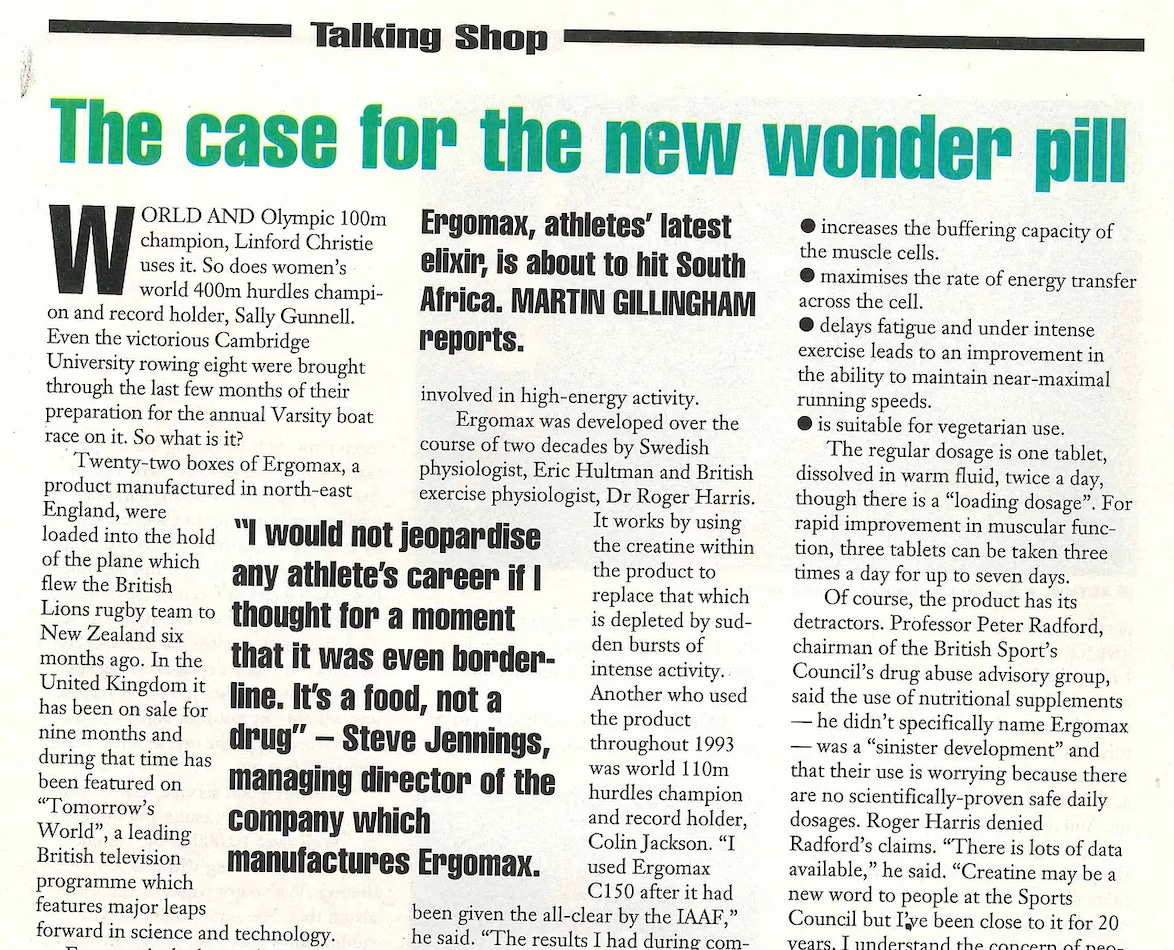
Two scientists, Professor Roger Harris and Professor Eric Hultman, decided to give Steve Jennings, the owner of a sports nutrition company (Maxim), a call.
They told him they needed to meet ASAP to go over some crazy discovery. A few days later, the scientists and Jennings met up at a country hotel in the north of England.
Professor Eric takes a wad of papers and boom—throws them down on the table.
In bold letters, the research showed:
Creatine monohydrate improves athletic performance in explosive, sprint-related sports by 1–3%.
This is groundbreaking. In sports where every second, even millisecond matters, increasing your athletic performance by 1-3% can be the difference between placing on the podium and not even qualifying for the race.
Since Jennings’ company, Maxim, was sponsoring the British Olympic track & field team, for the 1992 Barcelona Olympics, the scientists asked him for one massive favor:
Could Jennings supply the runners with creatine for the Olympic Games?
It was a tough ask. First, hardly anyone understood what creatine even was. And second, these athletes had trained for years without it—now their performance coach was suddenly saying, “Here, take this random tablet.”
But here’s what’s crucial about this story: creatine isn’t illegal.
It’s not a steroid or some synthetic lab-made supplement. It’s a natural compound—an amino acid found in muscle tissue in all animals. In fact, the first person to discover creatine was a French scientist, Michel Eugène Chevreul, who extracted it from meat back in 1832.
Being super low-key, Jennings and his brother came up with a supplement called Ergomax C150—a creatine tablet that dissolved under the tongue for the Olympic races. They dosed the boys and girls before the races.
Long story short: five of those athletes went on to win gold medals.
I imagine Jennings saying something like, “Shut up and take this—you’ll win gold.” And gold they won.
The sports world was like, Damn, what happened to those British lads?
Word soon got out. One sneaky journalist, Doug Gillon of The Glasgow Herald, caught wind of a rumor that British athletes were taking a secret “wonder pill.” He tracked down a box of Ergomax C150 and called Jennings directly.
He told Jennings he knew everything about Ergomax and creatine and basically said, “Spill the beans or I’m blackmailing you and saying everyone’s on steroids.”
Jennings was like, “Oh shit,” and told Doug to talk to Professors Harris and Hultman.
They told Doug to chill—it’s legal and just a food-based supplement.
Two days later, on July 28, 1992, Doug breaks the story:
“Scientists may keep UK athletes one step ahead.”
The thing went viral bonkers. Headlines exploded. Media swarmed. Critics cried doping. Jennings found himself at the center of a potential scandal.
But the naysayers were wrong. Creatine wasn’t a drug. It was food.
And once people realized it wasn’t something like TREN—but a legit, food-based supplement that could enhance athletic performance—every athlete wanted in.
By the 1996 Atlanta Olympics, 80% of athletes in explosive sports were using it.
That groundbreaking creatine research paper was finally published in September 1992: “Elevation of creatine in resting and exercised muscle of normal subjects by creatine supplementation.”
A new category in sports nutrition—and brain health—was born.
5 Common Creatine Myths—Debunked
I love that story.
This dude finds out creatine is the bomb, finds a way to turn it into a supplement, shoves it down innocent track stars’ throats, and gets everyone gold medals.
What a legend.
But unfortunately, with all amazing things, there will always be some nonsense dispersed.
By the time creatine was well established, I was only like 5 years old. So when I hit the scene at 15—trying to build muscle and get a six-pack for the 7th-grade girls—the haters, critics, and faux science were already well established too.
So I hear about creatine from a gym bro or athlete in line and I’m like, Wow, that’s epic, let me ask my parents if I can take it.
My mom pleaded with me: “Honey, it’ll make you lose your hair!”
My father winced in agony: “It’s basically steroids in disguise!”
And then there were the classics. I remember in my fraternity, one dude said he couldn’t take creatine because, quote:
“You need to drink hella water when taking it, and I like to booze hella which makes me dehydrated, so I can’t take it.”
(True story. He was right about drinking lots of water, though. Very healthy.)
Anyway, it took me years of trials and tribulations—learning how to actually interpret scientific studies, meeting with biohacking doctors, and trying it myself—before I finally learned the truth.
Wait... so those critics were lying all along?
Some of the rumors came from early (and often poorly designed) studies. Others were just gym bro gossip and media hype. And let’s be real—any time something helps people perform better, there will always be skeptics and fear-mongering headlines.
One scientific review literally broke all the myths.
Here are the 5 biggest myths—busted.
Myth #1: Bloating
Reality: Creatine does increase water in your muscles—but it’s intracellular water.
That means the water is stored inside your muscle cells, not under your skin. It can actually make muscles look fuller, not bloated.
Studies, including one published in the Journal of the International Society of Sports Nutrition, found no evidence that creatine causes the kind of bloating people fear.
Myth #2: Hair Loss (DHT)
Reality: This myth comes from a single 2009 study with rugby players that showed a slight increase in DHT—a hormone that contributes to male sexual characteristics.
That study was small, and no other studies have confirmed this link. In fact, newer research hasn’t found any direct connection between creatine use and hair loss.
Myth #3: Kidney Damage
Reality: Creatine does increase creatinine levels (a marker doctors use to estimate kidney function), but that doesn’t mean it harms your kidneys.
Dozens of studies—including reviews published in peer-reviewed journals—have shown creatine is safe for healthy individuals, even over long periods.
Myth #4: Only for Young Athletes
Reality: Research shows creatine helps prevent age-related muscle loss and has even been linked to improved brain function.
One review published in Nutrition Reviews found that creatine supplementation can improve strength and cognitive performance in aging populations.
Myth #5: Creatine Loading & Cycling
Reality: Loading is optional.
It can help saturate muscles faster, but consistent daily doses of 5–25 grams work just fine over time. (We’ll talk about my 25 grams soon, I promise.)
There’s no evidence you need to cycle off. This was confirmed in a Journal of Applied Physiology study way back in 2003—and we’ve got even more evidence today.
Creatine’s Proven Benefits (2025 Update)
So, with all of these myths out of the way, let’s get into all the amazing benefits of this stuff. And trust me—there’s a ton.
I’m not just talking muscles. I’m talking to you nootropic nerds too.
Here are my 6 favorite benefits of creatine.
1️⃣ Cognitive enhancement
Creatine helps fuel the brain’s energy systems—specifically the phosphocreatine shuttle, which supports ATP production.
Studies show it can improve short-term memory, intelligence tasks, and mental fatigue—especially in vegetarians, vegans, and people under stress.
2️⃣ Sleep Deprivation
This one is amazingly cool.
Creatine can reduce the mental fog from sleep deprivation.
A 2024 Nature study showed that a high dose improved reaction time and processing speed after 21 hours without sleep. Other studies found it supported mood and cognitive tasks after 24 hours awake.
Every time I stay out late, I make sure to dose 10 grams right when I wake up.
3️⃣ Neuroprotection & aging support
Not only does creatine enhance memory, attention, and processing speed—it also acts as a mild nootropic and can really help access flow state.
It’s even being studied as a therapy for Parkinson’s and neurodegeneration.
4️⃣ Muscle strength & size
You probably already know this one.
Creatine is one of the most beneficial supplements for muscle growth. Creatine boosts strength and muscle size by increasing ATP regeneration and cell hydration.
5️⃣ Athletic performance
Creatine improves power, sprinting, and endurance across almost every athletic domain. It enhances short-duration, high-intensity efforts and training adaptations.
I take 5–10 grams before my massive tennis matches with the boys at the courts.
6️⃣ Recovery & soreness reduction
Creatine helps restore muscle function faster after exercise. It can speed recovery and reduce muscle damage and soreness between workouts.
So after my insane tennis battles, I can actually recover and then… battle again.
Best Type of Creatine & Advanced Stacks
You’ve probably seen dozens of creatine types in supplement stores.
Creatine HCL. Creatine ethyl ester. Buffered creatine. Liquid creatine.
But there’s really just one creatine you should buy: Creatine Monohydrate.
It’s the most researched, most effective, and most affordable. Hundreds of studies have confirmed its superiority for strength, muscle growth, brain performance, and recovery.
Some other forms work, but not as well—and it all gets complicated real fast. So I suggest just sticking to the best of the best.
But…
If you want to try next level creatine biohacking, I have a supplement you need to try.
One of my sponsors for this newsletter (bless their hearts), LVLUP Health—came up with a creatine blend.
Founded by Kyal Van Der Leest, nutritionist and naturopath he combined creatine monohydrate with two other effective forms: Creatine HCl and Creatine Magnesium-Chelate.
Then he added Highly Branched Cluster Dextrin (HBCD)—a carb source that boosts creatine absorption and doubles as clean workout fuel. Lastly, he included something called GAA (Guanidinoacetic Acid).
GAA is a direct precursor to creatine that absorbs into cells far more efficiently than creatine alone.
One study found that four weeks of GAA increased muscle creatine levels by 16.9% (compared to just 2% for monohydrate)—making it over 8x more effective.
GAA also elevated brain creatine levels by nearly 4x.
To avoid potential side effects (like increased homocysteine), LVLUP smartly includes TMG (trimethylglycine), which supports safe creatine conversion and adds benefits for endurance and cognitive performance.
So it’s pretty cool. I use it a lot—especially pre-workout. I feel my brain turn on, and I definitely notice a difference. They also have the creatine blend included in a pre workout as well.
If you want to try it out, I’d recommend it. Here is the link. Use Code: BIOHACKWITHJACK
How to Use Creatine for Maximum Results
Since you now understand creatine is a very versatile supplement, it’s time to understand when to take it.
🧠 For Cognitive Performance
Dose: 10–15 grams in the morning.
Creatine can upset your stomach in large doses. I recommend splitting the dose—5 grams mixed into 8 oz of juice or water every 30–45 minutes until you hit your target.
🏋️♂️ For Muscle Growth & Strength
Dose: 5–10 grams pre-workout and then post-workout.
Stack creatine with:
Carbohydrates (pineapple juice is my go-to)
Sodium or electrolytes for better cellular uptake (Here’s my favorite electrolyte blend.)
😴 For Sleep Deprivation
Dose: 10 grams first thing in the morning, or 5 grams in the morning + 5 grams in the afternoon.
Pro tip: Add electrolytes to your morning dose for enhanced absorption and cellular hydration.
🔄 For Longevity Maintenance
Dose: 5 grams daily anytime.
⚠ Precautions
Water retention: Some is normal (muscle hydration). Not fat gain.
Stomach upset: Split larger doses into smaller servings.
Kidney/methylation issues: Speak with a healthcare provider if you have pre-existing conditions.
Final Thoughts & Where to Get Quality Creatine
By now, it’s clear:
Creatine isn’t just a gym supplement anymore.
It’s a brain booster, an energy enhancer, a recovery tool, and a longevity ally.
🏆 Best Sources
If you want to keep it simple and proven:
Creatine Monohydrate → Bulk Supplements or Thorne (both third-party tested)
For advanced biohackers or those wanting to stack:
LVLUP’s Creatine Precursor: Use Code: BIOHACKWITHJACK
If you’re building a foundational supplement stack, creatine should be non-negotiable.
It’s one of the few supplements that delivers real, measurable results—without the hype.
👊 Last word
Pick your goal. Dial in your dose. Start upgrading your brain and body today.
BOOM. Love you guys.
Hope this helped and cleared up any funky drama with creatine.
👇 Are you already using creatine? Got any questions regarding supplements?
Drop them below or shoot me an email—I respond to every message.
I’m grateful to my partners who create amazing health & wellness products.
Disclaimer. I am not a doctor. This is just some random stuff I learned on the internet. Pretend it’s a story. Ok bye.
Gaslight the movie, Ingrid Bergman, Charles Boyer
I have tried creatine monohydrate four times and more recently creatine HCL and did find them helping my workouts but each time also experienced rapid hair loss that stopped when I stopped taking creatine, so for me it’s just not worth it. Luckily I have gotten great results with other supplements like L citrulline, taurine,glycine and most recently NMN with TMG, all without any negative side effects.