

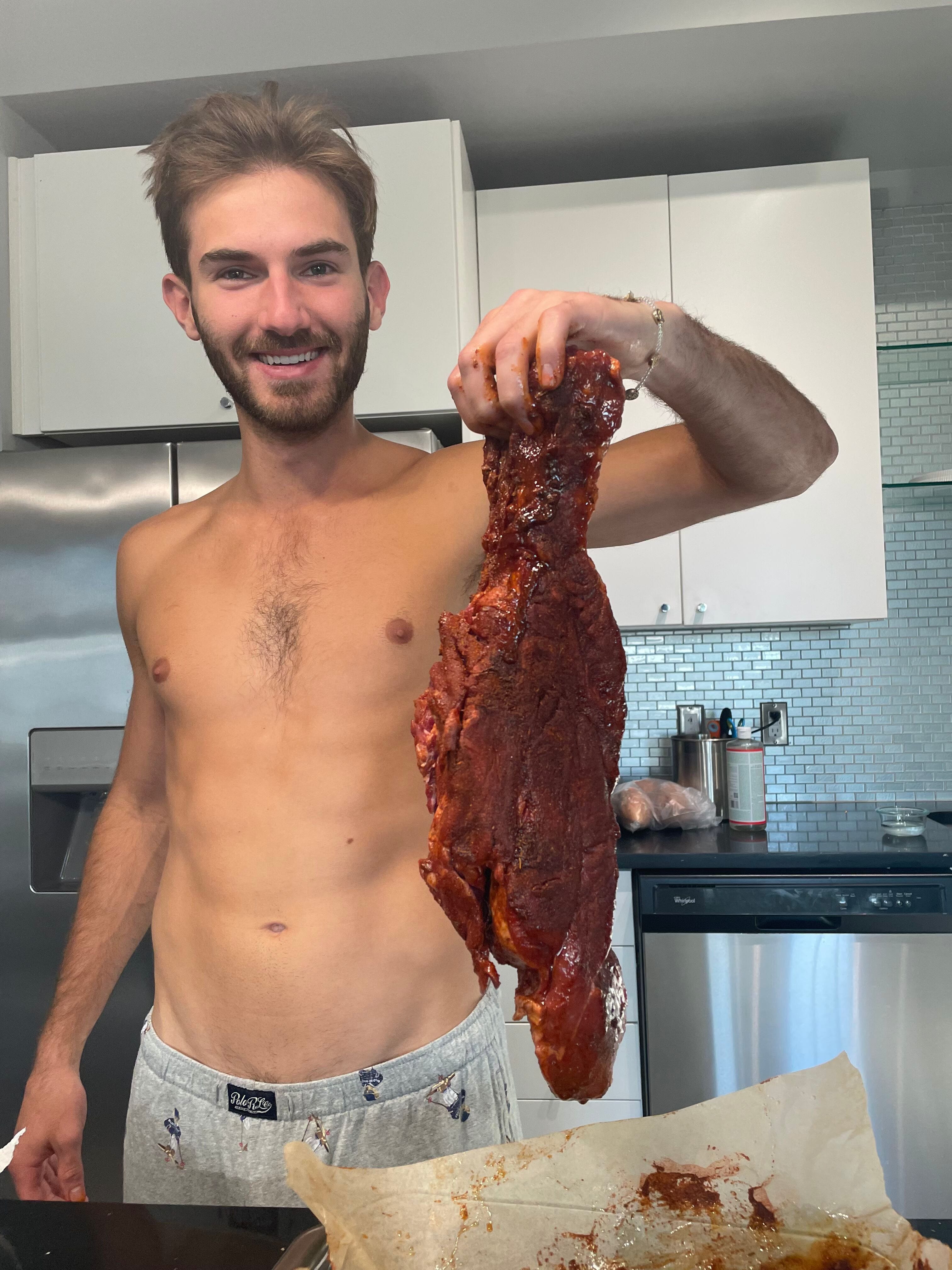
When I first got into fasting at 18, my goal was simple.
Look like the absolute man before college.
I'm talking about that bulletproof, V-line-six-pack energy.
So after learning about the fat-burning effects from fasting, I decided that achieving my washboard abs would require me to fast for 23 hours a day, 7 days a week.
To conquer the hunger my solution was to drink strong drink black coffee.
And mind you, I was brand new to coffee—like, baby-new. Just a tiny sip had me absolutely geeking. I’d get so hyped I’d blast Russian techno, grind through real estate financial modeling for hours, swing kettlebells like a madman, and ride that jittery wave straight through to 3 or 4 PM.
Then came my one and only meal of the day: the legendary dirty salad. A glorious, chaotic melting pot of lettuce and whatever leftovers I could scavenge from the fridge. Pasta bolognese? Toss it in. Short ribs with mashed potatoes? Why not. Leftovers from taco night? Straight into the dirty salad incinerator.
The longer I fasted, the more I convinced myself that every hour—every minute—I resisted eating, I was unlocking some mystical metabolic cheat code: mTOR dropping, AMPK rising, beta oxidation firing on all cylinders!
And for the first couple of weeks, it worked—and it felt amazing.
But soon enough, I started behaving like a primal caveman.
Most days, I was just praying my mom wouldn’t make tacos because if she did, fasting was instantly canceled.
These unnecessarily long fasts just left me sluggish and drained. My testosterone felt like it plummeted, my thyroid tanked, my brain fogged up, and my stomach wouldn't shut up. I was constantly hungry, irritable, and, honestly, miserable.
Looking back, it’s no surprise why so many people struggle with fasting. It’s demanding, stressful, and downright restrictive—it can feel like life is passing you by while you white-knuckle your way through hunger.
So in this article, I’m tackling one big question:
How do you get all the incredible benefits of fasting—supercharging your metabolism, unlocking boundless energy, and tapping into deep cellular healing—without feeling like you’re starving to death?
To even attempt this challenge, I had to rethink my approach. That meant deleting my first draft, resisting the urge to punch my computer, and actually sitting down to think.
But now? We’ve got the solution.
Let’s get into it. Vamos!
The History of Fasting: From Ancient Traditions to Modern Biohacking
The English word “fast” comes from the Old English fæstan, meaning “to abstain from food.” It dates back to around the 8th century—long after fasting had already been ingrained in human existence.
We had to hunt. We had to climb. We had to be patient, sometimes for days in finding our next meal.
That’s fasting.
Our bodies adapted to this rhythm—a constant cycle of give and take.
Feed and famine.
Energy and depletion.
We mastered this state so well that we essentially became Swiss Army knives of survival, storing essential resources—fats, proteins, and carbohydrates—ready to deploy when needed.
Because of this evolutionary adaptation, we could go long stretches without food.
And in response, our bodies developed key signaling molecules—AMPK, adrenaline, glucagon—all designed to keep us alert, sharp, and moving forward in a fasted state. These molecules didn’t just keep us alive. They gave us an edge.
What started as a survival mechanism evolved into something much more. Over time, humans came to see fasting as a way to clear the mind, revive the body, and discipline the spirit.
Hippocrates, the so-called Father of Medicine, prescribed fasting to his patients, believing it helped purge toxins and accelerate healing.
Indigenous tribes embraced fasting during vision quests, using it as a gateway to spiritual insight, mental clarity, and personal revelation.
And ancient warriors—from Spartans to Samurai—saw fasting as a tool for resilience, mental toughness, and battle-readiness.
Now, contrast that with today’s fasting craze.
From biohackers to Silicon Valley execs, everyone is skipping meals and testing the limits of how far "not eating" can push longevity, performance, and mental clarity.
And there are plenty of different camps in the fasting community.
We’ve got:
OMAD (One Meal a Day)
GOMAD (Gallon of Milk a Day)—okay, that’s not fasting, but it’s ridiculous enough to fit here
Juice fasts
Bone broth fasts
Urine fasts (yes, this is a real thing—some people fast and drink their own urine)
Water fasts (no food, no water—brutal)
Fat fasts (a.k.a. the butter coffee fanatics trying to biohack their way to 150 years old and win the Longevity Olympics)
And it’s no surprise that fasting is everywhere.
No surprise that scientists are obsessed with studying it. No surprise that millions are poured into fasting supplements, retreats, and tracking tools.
Because, simply put—it works.
The Science-Backed Benefits of Fasting
Improved Body Composition
Fasting for 12 hours or more has been shown to improve fat oxidation and fat-burning. It also increases the body’s secretion of human growth hormone (HGH), which helps preserve muscle and burn body fat.
More Energy
Ever notice how all mammals are active when hungry and lazy when full? That’s because hunger triggers adrenaline release—your body’s way of saying:
"Hey mofo, you’re starving. Here’s some adrenaline—now go get me some food, you mofo!"
Yes, the body is that sassy.
Appetite Regulation
The hormone ghrelin (a.k.a. the “hunger hormone”) signals when we’re hungry—sometimes so aggressively that it convinces us to eat an entire tub of ice cream.
On the other hand, leptin tells us when we’re full.
Fasting helps balance these hormones, allowing ghrelin to regulate properly so that leptin can do its job. When they’re in sync, appetite naturally evens out, reducing cravings and overeating.
Gut Health
Fasting can protect the gut from stress-related damage while increasing microbial diversity and enhancing fermentation rates—all of which strengthen the gut and immune system.
Immune System Health
Mouse models show promising results for autoimmune conditions like Multiple Sclerosis and Type 1 Diabetes. Researchers believe fasting removes damaged cells and stimulates tissue regeneration.
Brain Health
Fasting triggers autophagy in neurons, protecting nerve cells from degeneration. It also increases BDNF (Brain-Derived Neurotrophic Factor)—a hormone that helps grow new nerve cells and strengthen neural pathways.
This translates to:
Improved memory
Enhanced learning
Sharper overall brain function
Heart Health
Fasting improves several key markers of heart health, including:
Blood pressure
Cholesterol levels
Blood sugar regulation
Insulin sensitivity
Triglyceride levels
Longevity & Disease Prevention
Autophagy is your body’s built-in cellular recycling process—basically, a 24/7 housekeeping crew that clears out old, damaged cells and replaces them with fresh, healthy ones.
Improved Self-Control
Fasting is one of the best ways to train self-control. It forces you to resist instant gratification and focus on what really matters.
Personally, I’ve experienced major mental clarity, improved focus, and fewer urges for negative habits since incorporating fasting into my routine.
Why So Many People Struggle With Fasting
Fasting eliminates the need to drop thousands on some fancy NAD IV program or a $2,000/hr holistic health consultation just to extend your longevity.
You can just not eat.
But if fasting is so powerful, why do so many people struggle with it?
Simple: misinformation.
💭 "Won’t I lose muscle while fasting? I’ve got gains to make, Jack!"
💭 "What kind of fasting should I do? 12 hours? 16? 24?"
💭 "My family says I’ll feel horrible—aren’t I starving myself?"
💭 "Juice fast, water fast, intermittent fast, dry fast, urine fast… which one is best?"
And the biggest elephant in the room...
💭 "Wait… will this break my fast?"
How to Fast Without Sacrificing Your Life: A Simple Three-Step Plan
After running through all of these questions—and spending years in the fasting trenches—I’ve found a simple three-step plan that eliminates these worries.
Because here’s the truth:
We should not be sacrificing joy, special moments, or amazing dinners just because “sorry, I’m fasting.”
At the same time, we deserve to experience the metabolic, psychological, and spiritual benefits of fasting while still celebrating life to the fullest.
Yes, you can get the best of both worlds.
You just have to be strategic.
So whether you’re:
🔥 An athlete trying to build muscle
🔥 A mom trying to lose weight
🔥 Or a 23-year-old like me, trying to stay mentally sharp, keep my energy high, and get a NASTY six-pack…
This is for you.
Step 1: 12-Hour Fast
You might think a 12-hour fast is crazy. Or maybe, you think it’s not enough.
But if you stop eating at 8 PM, sleep through the night, and don’t eat until 8 AM—it might feel like you did nothing.
BUT LOOK AT WHAT YOU JUST GAINED:
✅ Gives your digestive system a break, supporting overall health.
✅ Stabilizes blood sugar and keeps energy levels steady.
✅ Encourages mindful eating, helping you separate real hunger from habitual snacking.
✅ Acts as a stepping stone for longer fasts down the road.
This is a gentle, beginner-friendly way to ease into fasting—way less intimidating than diving straight into a 20-hour fast. It also trains your mind and body to recognize the natural rhythms of eating and not eating.
How to Start a 12-Hour Fast
🥩 Finish dinner by 7 PM
⏳ No food, no calories, no butter coffee, no sneaky sugar—until 7 AM
☕ If you need something to hold you over, black coffee or tea works.
This method is great for beginners and especially beneficial for women, since hormonal differences can make shorter fasts a better fit. (Want to dive deeper into how fasting affects men vs. women? Check out reliable resources [here].)
Step 2: Time-Restricted Feeding (TRF) 15+ hours
I used to count down the minutes until I could eat again—desperate to hit that 16-hour mark. I’d either be starving myself or jacking myself up on caffeine, and by the time I could eat… I didn’t even want to anymore.
Then, I listened to a podcast and learned about time-restricted feeding (TRF)—and it completely changed the way I saw fasting.
Instead of focusing on how many hours I wasn’t eating, I shifted my focus to how many hours I would be eating.
My TRF Routine
For years, my routine has been pretty consistent:
☕ Coffee around 7-8 AM
🥩 First meal around noon
🍽 Last meal around 7 PM
That’s a 7-hour eating window. Some people do 4 hours. Some people do one hour, eating just one meal a day.
Funny enough, this approach made longer fasts easier—and before I knew it, I was doing 16-18 hour fasts with no struggle.
Why TRF Works
🔹 Improved Blood Sugar Control
Eating all meals within a 9-hour window has been shown to improve glycemic variability. Even better, an earlier eating window (8 AM – 5 PM) can lower fasting glucose. (Wilkinson et al., 2020)
🔹 Better Metabolic Health
Dr. Satchidananda Panda’s lab at the Salk Institute found that aligning eating periods with circadian rhythms (eating earlier in the day) enhances metabolic function. (Panda, 2016)
🔹 Fat Loss & Muscle Maintenance
A study in the Journal of Translational Medicine compared an 8-hour TRF window (16/8 fast) to a standard diet in resistance-trained men. Both groups gained muscle, but the TRF group lost more fat while maintaining strength. (Moro et al., 2016)
I’ve followed this fasting style for years, and it’s been the most sustainable and effective approach for me. It lets me train hard, stay lean, and feel energized—without feeling restricted.
While some studies use slightly longer or shorter windows (10-hour vs. 8-hour eating periods), the key takeaway is clear:
✅ Keeping your eating window consistent
✅ Eating earlier in the day
✅ Enhancing metabolic and overall health
How to Transition to TRF
Once you’ve completed the 12-hour fasting protocol for six weeks and feel comfortable with the rhythms of fasting and fueling, it’s time to level up.
I recommend starting with a fasting window of 10 AM – 7 PM (a 9-hour eating window, which equals a 15-hour fast).
Over time, you’ll learn what works best for you—maybe it’s 12 PM – 7 PM, maybe it’s 8 AM – 5 PM.
You’ll find your sweet spot—and you’ll love how you feel. 🚀
Step 3: Biohack Your Fast
Fasting is incredible, and its benefits are undeniable—but what if you could enhance them even further?
What if you could supercharge fasting’s effects while also building muscle, boosting energy, and sharpening mental clarity?
That’s where biohacking comes in. It also happens to be a bonus step!!
These are the best supplements I’ve found for fasting. Some may call it cheating, but let’s be real—what’s cheating when you’re just giving your body what it needs to feel great?
So once you’re comfortable with the 12-hour fast and have found your optimal feeding window, start experimenting with some of these fasting-friendly supplements.
Mix and match. Try a few. Or do what I do—take them all and become a biohacker tweaker searching for the next best way to feel high—uh, I mean… increase longevity. 😏🚀
Amino Acids: The Ultimate Fasting Hack
Whenever I’m at the office, hungry but slammed with work, I throw three large scoops of amino acids into my water—and suddenly, I’m good to go.
🚀 No hunger.
🚀 Focus and energy rebooted.
🚀 Cells getting exactly what they need for energy and repair.
And it’s not just a work hack—it’s a gym hack, too.
Amino acids are 10x more effective than whey protein when it comes to muscle preservation, energy, and recovery.
Why Amino Acids Work for Fasting
Amino acids are amazing for fasting because they allow you to stay in a fasted state while still fueling your body.
💡 Yes, they contain a small number of calories, but if you’re fasting for 16+ hours, I don’t believe they counteract the metabolic benefits—in fact, they enhance them.
These essential compounds are crucial for:
✅ Muscle maintenance – Prevent muscle breakdown during fasting.
✅ Cellular repair – Support gut health and tissue regeneration.
✅ Sharper focus & learning – Boost cognitive function.
✅ Faster recovery – Essential for athletes and active individuals.
✅ Better mood & stress resilience – Support mental well-being.
They do slightly spike insulin, but not enough to break a fast. And for athletes, bodybuilders, or anyone trying to maintain muscle (like me)—amino acids are an absolute go-to while fasting.
My Go-To Brand
Kion is my favorite brand for essential amino acids—I believe they have the most comprehensive and efficient formula for muscle building and sustained energy even while fasting.
🔗 Learn more about them here. Use Code koolhealth for 10% off.
Replenish Your Minerals: The Key to Optimized Fasting
When you fast, your body naturally depletes essential minerals, making it crucial to replenish them to maintain energy, hydration, and overall function.
Fulvic and humic minerals are game-changers—they enhance nutrient absorption, support detoxification, and help your body operate at peak performance, especially during fasting.
Key Benefits:
✅ Better Nutrient Absorption – Helps your body utilize vitamins and minerals more efficiently.
✅ Enhanced Detoxification – Supports your body's natural cleansing pathways.
✅ Increased Energy – Prevents fatigue and keeps you feeling strong while fasting.
My Go-To Routine
I swear by BEAM Minerals—I mix 1 oz of fulvic and humic minerals into my morning drink, along with an adrenal cocktail from Jigsaw Health.
This combo properly mineralizes my body first thing in the morning—and it’s honestly the best thing ever. 🚀
Nicotine: The Overlooked Fasting Hack
Nicotine helps with one of the most annoying aspects of fasting: hunger.
And no, it’s not just for getting a buzz in your mom’s basement—it’s a powerful nootropic and a highly underrated tool for fasting.
A study published in Psychopharmacology found that nicotine reduces hunger and increases metabolism, making it an effective appetite suppressant during fasting.
Brain Benefits of Nicotine
🧠 Enhances Memory – Improves short-term, long-term, and working memory while boosting memory consolidation.
⚡ Increases Alpha Brain Waves – Leads to sharper focus, better attention, and heightened creativity.
🔥 Anti-Inflammatory Effects – Modulates acetylcholine, reducing TNF alpha and cytokine production, which helps lower inflammation.
How to Use It
Try a piece of Lucy gum while fasting and tackle a deep work project.
🚀 For more on flow states, check out this article.
Exogenous Ketones: The Hunger Hack
If you never want to feel hungry again, these are your go-to.
Ketones are the fourth macronutrient, as explained by Dr. Dominic D’Agostino, and they come with a laundry list of benefits:
🔥 Increased energy – Fuels your brain and body without glucose crashes.
🔥 Sharper focus – Supports cognitive function and mental clarity.
🔥 Metabolic flexibility – Helps your body switch between burning fat and carbs effortlessly.
🔥 Appetite control – Naturally suppresses hunger, making fasting easier.
There are a ton of ketone supplements out there, but my go-to brands are HVMN and KetoneAid—both deliver a clean, effective ketone boost that helps me power through long fasts without the hunger struggle.
⚠️ Fair warning: They taste like rocket fuel—so brace yourself. 🚀
Caffeine: The OG Fasting Fuel
According to neuroscientists and performance experts, caffeine isn’t just a morning ritual—it’s a fasting supercharger.
And here’s why:
🔥 Caffeine suppresses hunger – Keeps ghrelin (the hunger hormone) in check.
🔥 Boosts adrenaline – Increases energy and mental alertness.
🔥 Enhances fat oxidation – Helps your body tap into stored fat for fuel.
🔥 Increases dopamine – Elevates mood and motivation.
I love the benefits of caffeine—the mental sharpness, the energy, the appetite control. It’s easily one of my favorite tools for fasting.
When I want to go longer on my fasts, I stick to black coffee—zero calories, pure focus, and a metabolic boost that keeps me in the zone. Check out my thoughts on what quality coffee truly means here.
🚨 Just don’t overdo it—or you’ll be geeking out like me.
Bulletproof Coffee (MCT Oil + Butter): A Metabolic Fast Upgrade
According to Dave Asprey, the founder of Bulletproof Coffee, fasting isn’t just about not eating—it’s about not spiking insulin and keeping mTOR levels low.
And here’s the trick:
🔥 Protein and carbs spike insulin.
🔥 Fats? They don’t.
By adding MCT oil and grass-fed butter to your coffee, you enhance ketone production and fuel your brain, making fasting easier and more effective—especially if you care more about the metabolic benefits than following a traditional “water-only” fast.
Other Amazing Benefits of Bulletproof Coffee
☕ Steady energy – No crashes, just pure focus.
🔥 Boosts ketone production – Helps your body burn fat for fuel.
🛡️ Supports gut health – MCTs have antimicrobial properties.
💡 Enhanced mental clarity – Keeps you in deep work mode.
Want to try it? Blend up some organic coffee, a tablespoon of MCT oil, and grass-fed butter—then see how you feel.🚀
Bonus: The Fat Shred Protocol
Start in a fasted state.
Make yourself a cup of coffee or green tea (or take some caffeine) to rev up your metabolism and fat burning.
Get into a cold plunge to activate brown fat adaptation, which converts yellow fat into brown fat.
Go for a walk to boost fat burning even more.
Try it out today!
☕ Coffee
❄️ Cold Plunge
🚶 Walking or Activity
Long Story Short:
Fasting isn’t about starving yourself—it’s about reprogramming your metabolism to work the way it was designed to. It’s one of the most life-changing practices I’ve ever tried.
Next time, we’ll explore the spiritual and psychedelic effects of fasting—the wisdom, intuition, and creativity you can unlock not just from food, but from anything.
Let’s dive into that next time. Hope you enjoyed this one. 🚀
Much love to you all. Remember to breathe. Remember to laugh. Peace. - Sandy
I’m grateful to my partners who create amazing health & wellness products.
Disclaimer. I am not a doctor. This is just some random stuff I learned on the internet. Pretend it’s a story. Ok bye.
Thanks for this. I have an eating window of between 6-8 hours. I was doing longer fasts, up to 36 hours but stopped because I was worried about muscle loss. A cardio angiogram showed up a small deposit of plaque in a major artery and I know longer fasting can clear this. Now, by using amino acids I can start fasting again. 👍
Ok slay